By Emma Baum | July 8, 2024 | Originally Published in Beautiful Things
After calling eighteen days in a row, I know not to hang up when my mom doesn’t answer after the fourth or fifth ring. Her phone is chronically lost, and I imagine her elbow deep in the living room couch or emptying her overstuffed purse onto the kitchen counter, one pair of glasses perched in her hair, another on her freckled nose.
When she answers, I tell her about the print of a woman in a boat I purchased from the campus poster sale to fill the still blank walls of my dorm. She asks for a picture. I hear when she sees it, how her breath trips and falls into a laugh before she tells me that The Lady of Shalott hung above her bed, too, when she was a student. I imagine my mom at eighteen, winding the phone cord around her fingers as she talks to her own mother. I long for a landline of my own, for a cord to coil around myself, tethering me to my mother’s voice. I laugh with her, and through the static, I can’t tell where her laughter ends and mine begins.
I give my mom the nineteenth day off. When I laugh at dinner with new friends and my last sight before sleep is the Lady, her boat just unmoored, something in me pulls taut, a caller wandering into another room mid-chat. Then I follow the line back to where all the best parts of me start and listen in.
Beautiful Things is River Teeth’s weekly online magazine featuring micro-essays of 250 words or fewer.
By Emma Baum | August 8, 2024 | Published in TheReportingProject.com
Kurt Scheiderer (left) was the principal at Broad Peak Elementary — formerly known as South Elementary — for 11 years alongside Assistant Principal Brian Wilkinson (right). This year, Scheiderer will take over as principal of Lima Ridge, and Wilkinson will be principal at Broad Peak. Image courtesy of Anna Davies
When Licking Heights Local School District elementary students head back to the classroom on Aug. 15, many of them won’t just be entering a new grade.
A redistribution of students among the district’s three elementary schools, designed to better manage rapid population growth, means nearly half of kindergartners through fourth graders — about 900 of the district’s 1,878 students enrolled in K-4 — will move to different buildings than those they attended last year.
“It’s been simmering for a while now,” said Licking Heights School District Communications Specialist Anna Davies about the need for a districtwide change. “I would say over the past 10 to 15 years, the district has been experiencing a lot of growth, but it’s really been a pretty sharp uptick within the last five years.”
The school district in western Licking County has about 5,600 students enrolled heading into the 2024-2025 school year – more than double the district’s student population in 2003. In addition to the redistricting efforts, a new, larger high school building was opened in the 2020-2021 school year. Just four years later, it is already undergoing construction of an addition that will allow it to hold 300 more students.
For the upcoming school year, young students will begin the year in three school buildings: Broad Peak Elementary, Everest Elementary and North Elementary, although North Elementary will be used only temporarily.
A newly constructed elementary school building – Lima Ridge – is set to open in October 2024, and will replace North Elementary, which will become the new home for Pathfinders Preschool. Lima Ridge students in kindergarten through third grader will start the school year in North Elementary, while fourth-graders will be temporarily housed at Summit Station Intermediate, which is home to the district’s fifth and sixth graders.
“I would say by 2030 we’ll have to build another elementary school,” said Lima Ridge Elementary School Principal Kurt Scheiderer. “Our numbers are quickly growing. You’ve got Facebook, you’ve got Intel; there’s a lot of land in our district and it’s being developed, which is a great thing, but managing the growth is challenging.”
While the redrawing of school boundaries is a big shift for students, families, and faculty alike, administrators are confident that the changes are both necessary and largely positive.
“Ideally, it’s going to allow us to have some smaller class sizes,” said Scheiderer, who added that the moves will make sure “that kids are not crammed into schools.”
“A lot of our English language learning classes, our intervention classes, have been in closets,” he said. “They haven’t been in classrooms. And so we don’t have to deal with that anymore, which is nice. Everybody is going to have a much nicer, more adequate space to provide quality instruction.”
That extra space, especially for English language learning classes, is vital as the district’s student population rises. Since 2016, the Licking Heights Local School District has gained nearly 700 English language learning (ELL) students, and about one in five students in the district are enrolled in ELL classes, according to a January 2024 article from WOSU.
Jhuma Acharya, the district’s family engagement and diversity specialist, said students in the Licking Heights school district speak more than 50 languages, with a significant number of students speaking Nepali, Somali and Spanish. Those students and their families moved to the district in the last decade seeking job opportunities and a sense of community.
“People see the school district as one of the main attraction points,” Acharya said. “They feel more comfortable sending their kids to this school, which is more diverse and a place where everybody is valued and respected.”
But as the population of the community increases, so do the needs of the school. Davies said the district is planning for even more student population growth in the coming years.
That extra space, Davies said, will allow students to get more personalized and individualized support.
“Having that additional space, we’re really trying to grow our paraprofessional support staff for this coming year, because we have a really big special education population,” said Davies. “Having more space in the schools – that’s going to allow more spaces where kids can get that more personalized support they might need, whether that be for language intervention, for reading or math intervention at the elementary level, and also just having more space to accommodate that growing special education population because students have such a unique range of needs.”
Redrawing school boundaries will also tackle transportation issues, such as low staffing and long routes – challenges faced by public school districts nationwide following the COVID-19 pandemic.
“We had a lot of really great feedback from our transportation department in the redistricting process,” said Davies. “Because they’re really well versed with the intricacies of our district, because they’re driving these roads and these routes every day, they offered some really helpful feedback that we ended up taking and implementing with the redistricting process.
In addition to the transportation department, the redistricting team led by Cooperative Strategies – a consulting firm that helps schools assess, design and manage changes such as redistricting – gathered extensive feedback from the community. Between November 2023 and February 2024, the district sent online surveys to families and hosted town halls, and superintendent Kevin Miller invited individuals with questions and concerns to meet with him one-on-one.
The result of these conversations was a commitment by the team to three goals in redrawing the boundaries: assigning entire neighborhoods to the same school, sending the largest possible number of students to the school closest to their homes, and accommodating future growth with minimal changes.
All neighborhoods were kept together in the final redistricting plan, and 63% of students – the highest percentage of any of the plans presented to the community – will attend the school closest to their home.
“We are just incredibly grateful to our community here at Licking Heights, because I feel like so many people are just really committed to helping the district be the best that it can be,” Davies said of the feedback and support the district has received. “If there’s one thing that I want to express, it’s just gratitude to the community for being so adaptable and being so involved and engaged.”
Elementary schoolers and their families can expect a warm welcome come August 14, when each school will host open houses, a chance for all students to get involved with their community, new and old.
By Emma Baum | August 1, 2024 | Published in TheReportingProject.com
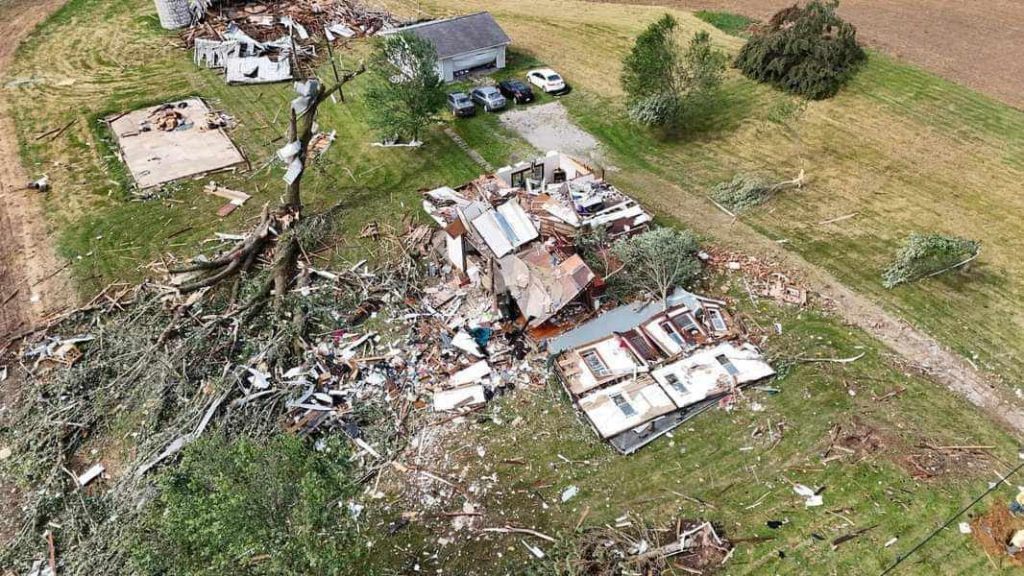
Neighbors and emergency responders in Frazeysburg have called it a miracle: A tornado traveling 130 miles per hour strikes a small town without warning in the middle of the night and leaves just eight people injured in its wake.
Sarah Caslow and Corey Roby, whose home was destroyed in the June 6 storm, agree. But that doesn’t make the grief of losing their home, most of their possessions, and the life they once knew any less painful.
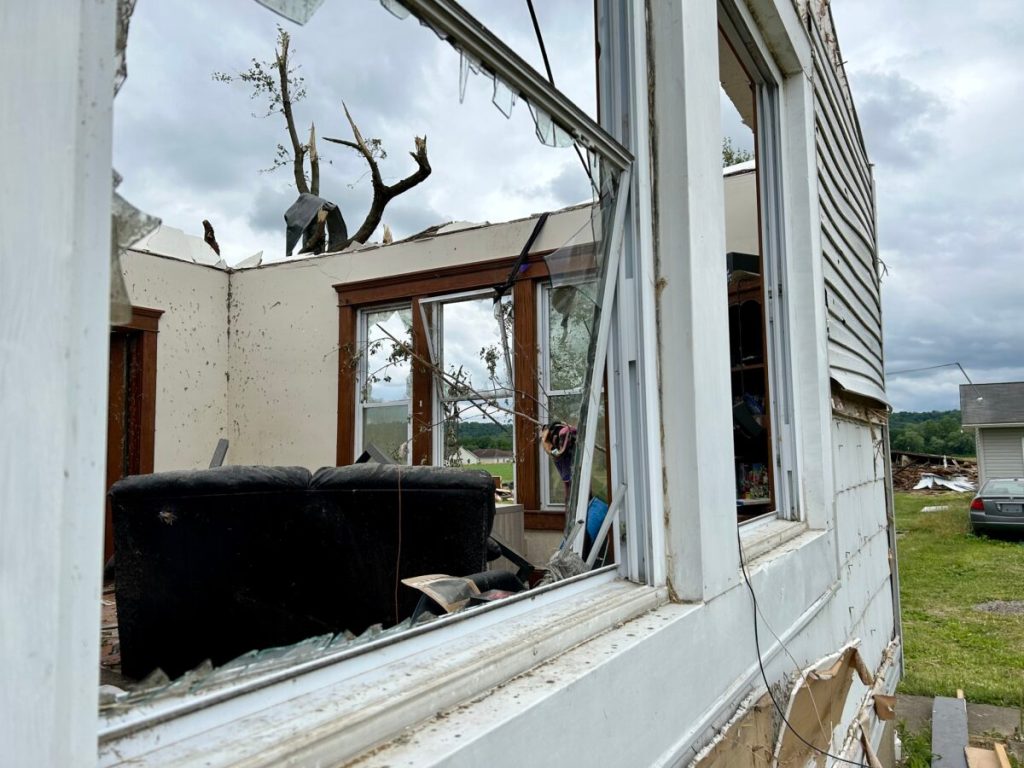
Caslow, Roby and their two roommates were enjoying a slow Wednesday night – a nap on the couch, a video game on the living room computer – when their house on the outskirts of Frazeysburg in Muskingum County took the full brunt of the tornado. The two-story home, a rental that had been lived in by members of Roby’s family for seven years, collapsed. Caslow required stitches for the gashes on her left arm from the windows that blew out and flew through the air like shrapnel. One roommate’s cat was sucked out a second floor window.
The four friends, barefoot, bruised, and bloodied, managed to find one another amidst the pitch black of the late night hour. Emergency Medical Services were called to the scene. By 3 a.m., the Red Cross had arrived, setting up in the local elementary school to provide care to Caslow, Roby, and their neighbors on West Third Street, the only area of town to be hit.
In all, the brief but powerful tornado that swept through the community destroyed eight homes and four businesses, and caused major damage to 3 homes and minor damage to another 40 homes, according to the Frazeysburg Police Department.
Corey Roby’s home was destroyed by the June 6 tornado that swept through Frazeysburg. Image courtesy of Corey Roby
“The whole town kind of banded together,” said Roby. “Everyone was helping each other. Everyone was stopping by to make sure we were okay. People in town thought no one was home because nobody died.”
The immediate outpouring of support from the community was something that struck Red Cross Disaster Program Manager Taylor Anderson. Anderson coordinated the response to the tornado, which involved working with the local Emergency Management Agency as well as the fire department.
“The thing that stuck out the most to me in this response was just the resiliency of the community,” said Anderson. “We had Red Crossers on the ground immediately. But the donations we were receiving were from family owned restaurants and all different towns coming over to drop off dozens and dozens of pizza boxes and Gatorade and pallets of water. People were coming to donate, people were coming to offer help. It was just a really strong, really beautiful community response, and it was cool to see that.”
It’s a trend that Anderson has noticed in many of the more rural communities that she works with: though there are often fewer social safety nets, when disaster strikes, the resilience of individuals and their neighbors is put on full display.
Caslow and Roby, who have been staying with family in nearby Dresden, are proof of that. Their experience is also a testament to the gaps in systemic support that exist, both before and after disaster has occurred.
“Our lives were destroyed because of a lack of radars,” Roby said of the gaps in National Weather Service radars that left his household without a warning or an opportunity to take shelter. “We could have avoided stitches and strokes. Why do we have these blind spots?”
Due to the trauma and stress of her experience, Caslow, who has high blood pressure, suffered a stroke the day after the tornado. While she has made progress in regaining control of her right arm and right leg, the loss of her independence, in addition to that of her home and years of mementos, sometimes feels overwhelming.
“The more that we start talking about it to kind of process it together, the more bits and pieces start coming back,” said Caslow. “Little by little I’m remembering a little bit about what happened, but it was a whirlwind — quite literally.”
In the nearly two months since the tornado struck, the couple has been wading through an insurance claim in hopes of replacing their possessions. Some items, like a cap and gown from graduation and Roby’s collection of nearly 1,000 books, are not so easily replaced, though. Most of what wasn’t destroyed in the initial storm was ruined while sitting in Caslow and Roby’s front yard, exposed to the elements. In the chaos of Caslow’s medical issues and a condemned categorization of the house that required the couple to have a police escort to return to their home, most of their possessions became unsalvageable.
For Caslow and Roby, it’s been a lesson in what’s truly important. They will be grieving the home they had hoped to build a future in for a long time. They count themselves lucky, though.
“We’re here,” said Roby. “It puts in perspective what matters.”
By Emma Baum | July 17, 2024 | Published in TheReportingProject.com
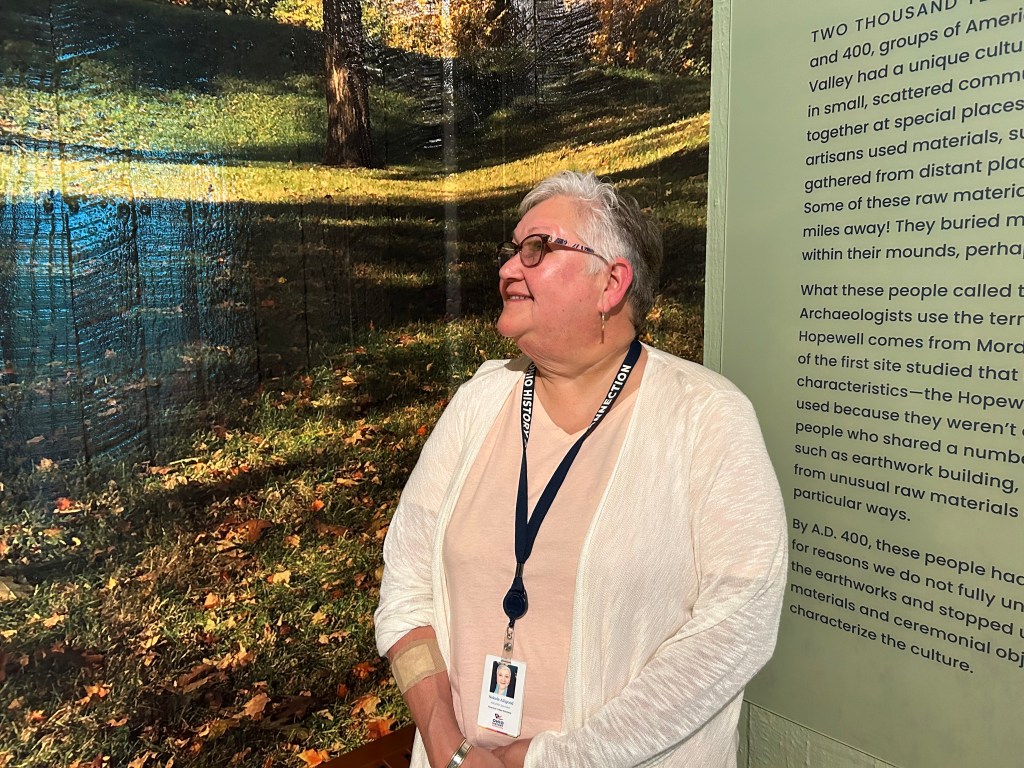
Nekole Alligood in an exhibit about the Newark Earthworks that she helped to develop at the Ohio History Connection. The exhibit prioritizes photos and diagrams instead of displaying actual cultural objects. Credit: Emma Baum
At the end of a long day of work, Nekole Alligood says goodbye to her charges, flips on the night lights lining the room, and closes the door behind her. Sometimes they answer back: a whisper of her name or a knock from the top shelf. After three decades in the business, Alligood, the Native American Graves Protection and Repatriation Act (NAGPRA) Specialist at Ohio History Connection, knows to just keep walking.
“I talk to my folks that I take care of,” said Alligood, 60, who relocated to Flint Ridge Memorial State Park from Oklahoma for the job in 2021. “Whenever I have a new intake, I introduce them and ask everyone to be kind to one another.”
Her “folks” are the largest collection of unrepatriated Native American human remains in the country. ProPublica estimates the remains of 7,167 individuals were housed in Ohio History Connection’s collection facility in early 2023, though Alligood calls that number conservative.
“We are the unofficial state repository for human remains,” Alligood said of criticisms of the institution’s staggering collection. “We will never be empty. There’s always going to be intakes. The construction of roads, construction of homes, erosion, there’s all kinds of things that will bring folks to the surface. If you’re not going to put them back, then they’ve got to go somewhere.”
The only place many of these remains are going, though, are the shelves of Ohio History’s facility. Under NAGPRA, a federal law enacted in 1990, agencies and institutions that receive federal funds must repatriate all Native American remains and other cultural items in their possession to the appropriate tribe, through a process of defining cultural affiliation with contemporary tribes.
In theory, it might seem like a program dedicated to belatedly righting some very grievous wrongs. In practice, it is illogically funded and easily evaded by some, Alligood said.
“At the end of every [grant] I’ve written, ‘National NAGPRA needs to increase the grant size or create a standalone grant to employ people to do this work that the federal government has mandated,’” said Alligood, who worked as the NAGPRA Officer for her own tribe — the Delaware Nation of Oklahoma — prior to joining Ohio History Connection. “The biggest issue is not having enough people.”
At Ohio History Connection, Alligood works with full time NAGPRA cataloger Stephanie Kline, a part-time NAGPRA assistant, and a handful of unpaid interns, often students from The Ohio State University with an interest (and a know-how) in osteology. Her requests for a third full time NAGPRA employee have gone unanswered.
Alligood and her team approach the task of determining cultural affiliation by grouping eight to nine Ohio counties into clusters. All of the remains and material found in a specific cluster are examined and presented to the tribes together, a process that can take years from start to finish.
The first cluster, eight counties in the northwestern corner of Ohio that Alligood grouped in 2021, produced their first repatriation in June, when a group of remains claimed by the Miami were reburied on Otterbein Island. A second group, claimed by the Shawnee, will likely be laid to rest at Johnston Farm in Piqua, Ohio, where a secluded five-acre piece of land has been set aside for such burials.
“Our general rule among removal tribes is, we’re not going to bury these people where we live now,” Alligood said, noting that every tribe that once inhabited Ohio was forcibly removed from the area by the Indian Removal Act of 1830. “They’ve never been [there]. So being able to have this burial ground is really important to me too, because we can offer space for tribes that need to put their people in Ohio, but don’t necessarily have land.”
It isn’t just the reburials where the culture and traditions of the tribes are honored, though. Alligood makes efforts to ensure that the human remains in her care are treated with the respect owed to ancestors.
At the request of the tribes, Alligood and her team bundle each set of remains with unbleached muslin and cotton twine once examination has been completed. Before the inventoried boxes are returned to the shelves, bags of tobacco and cedar, handmade by Alligood to feed and calm the spirit, respectively, are placed alongside the bundles. After a reburial, the box that once held the remains are burned.
It’s these everyday dignities that keep Alligood from becoming overwhelmed by the work ahead of her, and by the silent displacement of the deceased that surround her.
The tribes aren’t asking for their human remains and cultural objects back out of selfishness, says Alligood. Raised by her grandparents, she can recall her grandfather’s stories of his time at a government school, and the language that he and his siblings were all fluent in but never spoke outside of the house.
“It’s not a ‘get even’ or a ‘gotcha’ or anything,” said Alligood, reflecting on why repatriation is so important. “It’s a, ‘Hey, those belong to our people and there’s not much that does anymore.’ So they’re important, I think, for tribal morality and spiritual morality, for [the tribes] to feel good knowing that their ancestors are at peace.”
Alligood knows there’s a long road ahead of her to make that peace a reality for every tribe. She dreams of a collaboration among the six museums that hold Hopewell remains to inventory the collections, consult with the tribes, and hold a group repatriation ceremony.
For now, though, she has her eyes set on the two reburials set for this summer, a consultation on the current cluster’s associated remains scheduled for August, and the Ohio Tribal Nations Conference, which will be held from October 21 to 25.
There’s a story that Alligood likes to tell when asked why she uprooted her life to move across the country and start a new job at an age when most are starting to eye retirement. It starts on a hot fall day, on a mountain in West Virginia free of roads and power lines: the perfect place to finally lay to rest the remains of two adults and three children, decades after they had been unearthed.
“We were preparing [the remains], bundling them for burial,” said Alligood, glancing down at her hands. “Just as we were about to walk over and place them in the ground, this breeze, just out of nowhere, came through. And all the leaves were circling and falling in it. And all of us just stopped. Everybody’s looking at each other. All I could think is, ‘There’s your thank you.’”
By Emma Baum | July 1, 2024 | Published in TheReportingProject.com
The Community Partners Council of United Way of Licking County met Wednesday, June 12 for its monthly forum series, which is open to the public and features a panel of experts on topics with local relevance, ranging from food insecurity to harm reduction.
June’s forum on Elder Abuse and Neglect featured panelists Miranda Anandappa, a senior staff attorney specializing in senior-focused impact work at the Columbus office of Legal Aid of Southeast and Central Ohio (LASCO); Melissa Armstrong, a social worker in the Adult Protective Services Unit at Licking County Job and Family Services; Abby Ortman, the Fraud and Security Coordinator at Park National Bank; and Licking County Aging Partners’ Client Services Director Kristi Blust, RN.
Abby Ortman, Kristi Blust, Miranda Anandappa and Melissa Armstrong discussed concerns related to elder abuse in central Ohio during the June meeting for the Community Partners Council of United Way of Licking County. Credit: Emma Baum
“The number one thing that we see is neglect related to our seniors,” said Blust. “But we also see self neglect or behavior that’s threatening to their own selves. We see emotional, mental anguish, and then least on our list is financial.”
While Blust does not primarily address the financial struggles of older adults, she and her fellow panelists acknowledged that money is increasingly becoming an issue for the people they work with.
The 2023 Asset Limited, Income Constrained, Employed (ALICE) Report – which documents Americans who earn more than the Federal Poverty Line, but cannot afford the essentials where they live – estimated the living expenses of a single senior in Ohio to be $2,322 a month, or $27,864 annually.
“What we’re seeing is, our older individuals are living on Social Security at 1940 and 1950 wages in 2024 and they’re just not making it,” said Armstrong. “I had a home visit yesterday with a gentleman who is bringing home $776 a month. That’s all the income he has.”
The ALICE Report found that while Ohioans 65 and older have the lowest rate of poverty, they are the most likely of any age group to be living in the limbo between the Federal Poverty Line and financial survival.
The panelists have seen a rise in unhoused older adults as a result of these financial constraints, long waitlists at senior living facilities due to the large number of adults who are aging into a need for some level of care, and rules that prevent individuals with felonies or past evictions from qualifying for senior housing have also contributed to this.
The issue of money is older adults has been further exacerbated by a rise in fraud and scams aimed at this demographic.
“We see a lot of electronic email scams, phone scams, individuals being contacted urgently to send money to pay bills, things that maybe they do believe they owe,” said Ortman. “These individuals are sending money, they’re constantly in communication with someone who they believe to be who that person says they are. It’s important that we can recognize when that individual is being scammed very quickly. We don’t want to get too far.”
“People are not just being taken for $1,000 here, or $1,500 here,” Armstrong added. “We’re talking life savings, retirements.”
A concern among many of the over thirty audience members seemed to be the potential for developments in AI to further the prevalence of online scams targeted at older adults. While none of the panelists had first-hand experience with this complication, several of them urged older adults, and those who care about them, to be hyper vigilant when dealing with online communications, even those that seem to come from a trusted source.
“There’s a lot of good in this community that’s happening and I think people need to tap into those,” Armstrong said in addressing possible solutions, such as the low fare, three-route Licking County Transit bus system, to the struggles older adults face. “We need to be aware of our community resources and get that word out to our seniors, because I think they’re going to need to access [them] more and more.”
The United Way of Licking County’s Community Partner Council will meet at 10 a.m. on July 10 at the Licking County Aging Partners for a panel on the topic “Everyone Needs to Belong.”
By Emma Baum | June 26, 2024 | Published in TheReportingProject.com
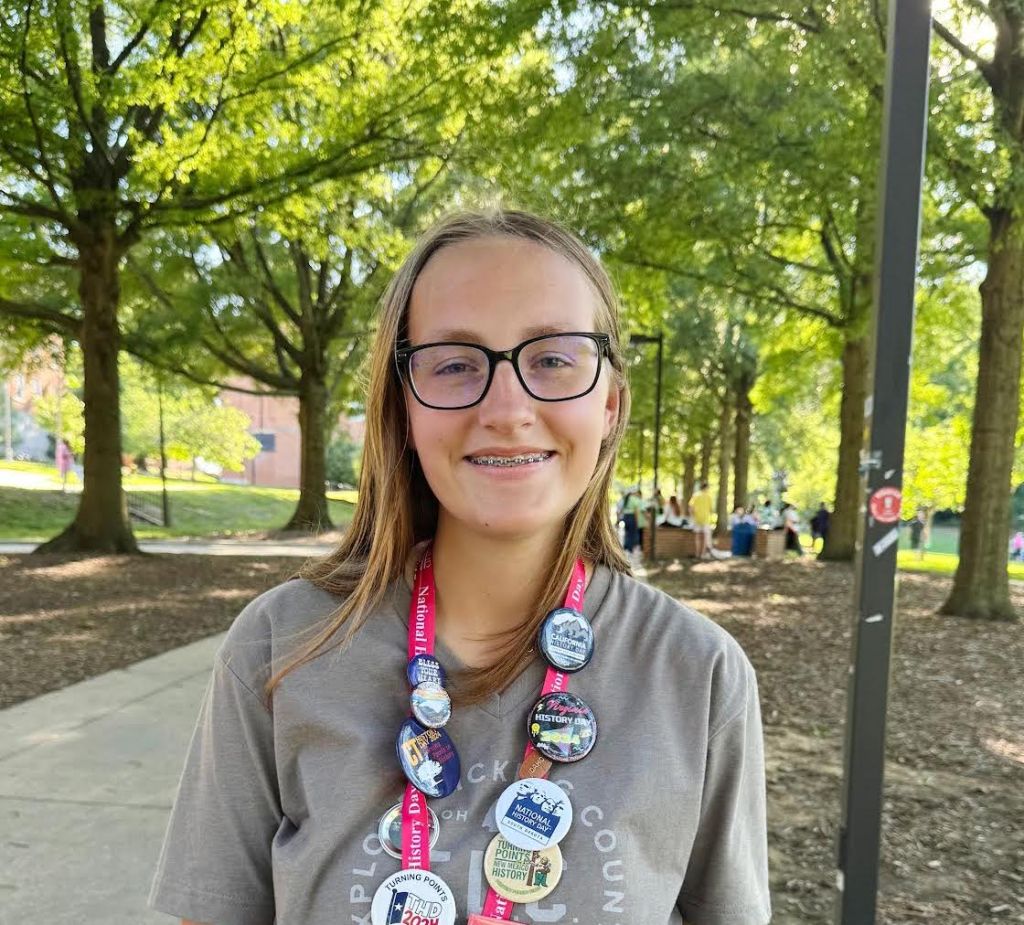
Alaina Appleman brought her project on airline deregulation to the National History Day contest this year — the first St. Francis de Sales middle school student to do so in decades. Image courtesy of Laura Appleman
While most 14-year-olds were enjoying a few extra hours of sleep and spending the afternoon at the local pool, Alaina Appleman spent the second week of her summer break presenting original research to a panel of judges at the National History Day Contest at the University of Maryland, College Park.
Currently in its 50th year, National History Day is a nonprofit organization that aims to improve teaching and learning of history at the middle and high school levels through student-led historical inquiry and research. Students across the country, as well as in regions ranging from Puerto Rico to South Korea, develop a research topic with relevance to the annual theme; this year, it was “Turning Points in History.” After conducting initial research on their chosen topic, students then decide which of five presentation options – documentary, exhibit, paper, performance, or website – would best fit the story they are trying to tell.
When the time came to choose a topic for her History Day project in Stacey Smith’s eighth-grade social studies class at St. Francis de Sales School in Newark last December, Appleman didn’t have to think too hard. The oldest grandchild of Paul Kaparoff, who spent over 30 years in airline management, Appleman has grown up tagging along on trips that have taken her everywhere from France to Australia. Inspired by her and her grandfather’s shared love of travel, Appleman chose to create a website about the Airline Deregulation Act of 1978 and its impact on commercial aviation for her project submission.
“For all my other projects I had to do, like for Science Fair, I chose to do boards, and they’re sort of boring,” said Appleman of her decision to present a website rather than the more traditional exhibit board or academic paper. “You don’t get to have fun with it and design it. But when you do a website, you get to choose the font and design all the colors.”
Both the Science Fair and National History Day are staples of the seventh and eighth grade curriculum at St. Francis de Sales, where Appleman was a student. Students are required to do a research project during both years of junior high; those who compete in the Science Fair in seventh grade must compete in National History Day in eighth grade and vice versa.
“What we encourage is for them to become an expert on their topic,” said Smith, who has been the junior high social studies and religion teacher at St. Francis for 39 years. She estimates that she has been doing National History Day with her students for at least 30 years. “A lot of times students aren’t in a situation where they feel like they are the expert. But I think this project challenges [them] to grow in all of those areas.”
After receiving feedback on her project from judges at the local History Day fair, Appleman was named a state qualifier in the Junior Individual Website category at the regional competition hosted by Ohio History Connection on March 9. On April 20, Appleman took first place in the category at the state level, securing her advancement to the national contest.
Smith attributes the successes to Appleman’s ability to apply feedback and adapt her project as necessary.
“She really listened to what the judges and the teachers said and made her project better all the time,” said Smith.
Appleman is her first student to advance to the National Contest. “She also chose something she loved. At every level, there’s interviews by the judges. And so if you love what you’re doing, I think that comes across in your interview.”
While Appleman did not place at the national contest, the experience – from research to representing the state on a national stage – has certainly made an impact.
“I’ve loved watching her confidence grow,” said Laura Appleman, Alaina’s mother. “She’s very mature, and I can’t wait to see what she does with her life, because I think she’s destined for pretty amazing things, and she’s just a hard worker. My husband and I just are in awe of the passions that she has.”
Appleman might be just entering high school, but she can already see herself pursuing history in the future. It’s an interest that has been informed by the passion of those who came before her.
“It’s amazing how history is instilled from generations,” said Laura Appleman. “[My dad] showed the importance of travel and experiencing the world to my sister and I, and then he’s made sure to do that same thing with his grandkids.”
While the national contest winners were announced just days ago on June 13, National History Day has already announced the theme for next year’s contest, which Appleman is considering entering. For the next few months, though, she’s looking forward to taking a break and enjoying life in the present.
By Emma Baum | June 24, 2024 | Published in TheReportingProject.com
The Granville Inn, a community staple in the village, is celebrating its centennial in June 2024. Credit: Emma Baum
A staple of fine dining and fashionable society since it opened its doors in June 1924, the Granville Inn kicked off its centennial celebration on Sunday afternoon with a revival of its bygone afternoon tea service.
With tickets for the event selling out in less than 24 hours, the Inn plans to implement bimonthly afternoon teas, part of its initiative to both recall the past and strive for the future as it reaches triple digits.
“So many people will say, ‘Oh, we got married here 40 years ago,’ or, ‘We’ve been coming here since I was a kid with my grandparents,’” said Food and Beverage Director Ben Schulman. “We’ve gone through a lot of renovations. So it’s a new feel, but we still get the same people coming back saying ‘I was here for’ whatever it was. I think the big part that we’re carrying forward is, we’re still that place that people come when they want to celebrate.”
The Inn, which was originally the project of coal and railroad tycoon John Sutphin Jones, is giving the community plenty of excuses to celebrate this coming week. On Wednesday evening, the Granville Inn will host a ticketed Centennial Gala, complete with period inspired cocktails from the Bee’s Knees to Blood and Sand and a “dress to impress” code of attire.
As the grand finale of a week’s worth of festivities – and a century’s worth of history – the Inn aims to recreate the June 26, 1924 grand opening of the hotel, which is said to have been attended by 5,000 guests. On Saturday, the lawn of the Granville Inn will host live music, food and drink, and family-friendly activities in a modern reimagination of that first event.
“It’s kind of our treat back to the community for supporting us for the past hundred years,” Schulman said.
The inn plans to celebrate the 100-year anniversary all year, with periodic events and bimonthly teas.
“Granville Inn is proud to celebrate a century of time-honored tradition and close-knit community values,” Brooke Walton, the inn’s general manager, said in a press release. “We eagerly anticipate commemorating this milestone achievement throughout the year, reaffirming our commitment to excellence in dining and hospitality.”
The hotel hopes that by inviting the community out for a day of play, it will usher in a new era where the Granville Inn is a destination for the small celebrations – the made-it-to-Friday wins – as well as the big. With one eye on the past, the Granville Inn is stepping into a new century, and it’s ready to have some fun.
By Emma Baum | June 13, 2024 | Published in TheReportingProject.com
Cory Bailey was in the bathtub early last Thursday morning when a tornado raced down West Third Street in Frazeysburg at a speed the National Weather Service estimates was up to 130 mph.
She wasn’t seeking shelter in the windowless room or her basement as the National Weather Service advises people to do – because she had no warning it was coming.
The Village of Frazeysburg and the tornado that ripped through it last week are an example of what some say is blind spots in the nation’s radar system that allows the weather service to provide warnings.
Frazeysburg is on the western edge of Muskingum County, which is at the farthest reaches of the radar in the Pittsburgh weather service office more than 100 miles to the northeast. And Licking County, the eastern border of which is within 5 miles of Frazeysburg, is at the outer reaches of the radar at the Wilmington weather service office more than 100 miles to the southwest.
A report to the National Oceanic and Atmospheric Administration Science Advisory Board by the board’s Environmental Information Services Working Group in November 2023 recommended immediate action to address poor coverage or gaps in radar coverage nationwide, though that “immediate action” is still years from fruition.
“Unfortunately, the (next radar) generation project implementation is still years away and there are well established solutions that would be highly beneficial in the shorter term,” the report summary said, but it does not appear that such changes are in the works for central Ohio.
So in the minutes before the window of Bailey’s adolescent sons’ bedroom was sucked out of its frame, and before the front door of her house was shattered and blown into the kitchen, Bailey was enjoying a relaxing soak in the tub, blissfully unaware of what was hurtling toward her.
A tornado warning issued by the weather service earlier in the night had been canceled at midnight. The local police station and Facebook community news pages declared an all-clear.
“There was a siren that went off an hour before that,” said Brandy Reprogle, who was forced to wait out the almost four minutes of high-speed winds and flying debris from her bed in her Dutchmen RV camper.
“But nothing when that hit,” she said about the lack of a warning. “Nothing. Absolutely nothing.”
Miraculously, the tornado left just eight minor injuries in the wake of its rush through the village of 1,347 people just east of Licking County in Muskingum County.
Along West Third Street, the only area in town that sustained serious damage, tufts of dirty pink insulation still clung Monday to bent chain-link fences, and curbside piles of splintered wood and broken tree limbs grew as residents cleaned up the mess. Power was back on by Monday, but the local Family Dollar store, where a billowing tarp covers the part of the roof, is shuttered.
“It’s amazing,” Bailey said from the passenger seat of the one family vehicle that does not currently have a shattered windshield. “It’s amazing. It could have been so much worse.”
And it’s remarkable that it wasn’t much worse because, without a warning, residents did not have time to seek shelter before the tornado hit.
Tornado warnings give people living in areas facing imminent danger time to take protective action, such as moving to the lowest floor of a building, or to a windowless room in the center of a house with no basement. Or, in the case of those in mobile homes, to head to the nearest substantial shelter. Staying safe in a severe storm requires taking shelter, and taking shelter requires advance warning.
So where was the warning in Frazeysburg?
“It can be difficult to warn for short-lived, weak tornadoes, such as EF-0 and EF-1s, because they spin up and end so quickly that radar may not detect them,” said Maureen O’Leary, a spokesperson for the National Weather Service.
The tornado that hit Frazeysburg, though, was reported by the weather service office in Pittsburgh to be an EF-2 level tornado using the Enhanced F-scale, which rates tornadoes by wind speeds ranging from 65 miles per hour (EF-0) to 200 miles per hour or more (EF-5).
Frazeysburg is an example of the blind spots that some have been warning about for years. The Washington Post wrote about this national issue as tornado season began in March, describing three severe weather incidents that came without warning.
Because Licking County and Muskingum County are both at the far reaches of their respective radar’s visibility, they are at points where the radar beam travels farthest from its transmitter. The altitude of the beam increases at its outer limits, which can make it more difficult for experts watching the radar signals to know what is happening close to ground level at those points.
According to the National Weather Service Radar Coverage Map, there is a diagonal strip from northwest Ohio to southeast Ohio where the altitude of the bottom of the beam of the WSR-88D radar is 6,000 feet above ground level, rather than 3,000 feet above ground level, as it is in most areas of coverage. This strip goes directly through Licking and Muskingum Counties, indicating that forecasters might have more trouble seeing weather structures in these areas.
The weather service assures that central Ohio, which is covered by the agency’s Wilmington office as far east as Licking County, and the Pittsburgh office starting in Muskingum County and going east, is not a radar dead zone.
Sheila Thompson, a Licking County resident with advanced weather-spotter training from the weather service, believes otherwise.
“In tornado land, they’re always looking for that ‘hook echo,’” said Thompson, pointing to a picture she had taken during her training that compared radar resolution images of a storm 150 miles from the radar and a storm 60 miles from the radar. “You can see it [at 60 miles]. You can’t see it [at 150 miles]. All you know here is that that’s probably a storm. That’s all you know.”
Usually, this is where local weather spotters would become the eyes of the weather service. But in a situation like the one in Frazeysburg, when a tornado occurs in darkness and in combination with heavy rain, even highly trained spotters are unable to see distinct features of storms, Thompson said.
Being able to identify the location, speed, and direction of activity, whether using radars or weather spotters, is what allows the public to be warned of weather events and take proper precautions before they happen. Without clear visibility, though, that identification can’t happen.
The weather service maintains that the radars servicing central Ohio provide adequate information on all communities in the region, even those on the edge of coverage zones.
For now, residents of Frazeysburg are helping one another pick up the pieces in a reality none of them thought could exist outside of a movie. Still left wondering what went wrong Thursday morning, they know one thing for sure: The tornado might have been strong, but the community they are rebuilding is stronger.
By Emma Baum | June 6, 2024 | Published in TheReportingProject.com
As the doors of the Licking County Transit bus slid open to let off its only passenger on a recent Wednesday afternoon, two men hurried down the sidewalk, one trailing after the other.
The bus, following the three-month-old “green line” from Granville to Newark, is one of three that operates along three “deviated fixed routes,” covering a 12-mile stretch of Licking County from east to west alongside the red Main Street line. The blue 21st Street line covers just over 5 miles from North to South.
“Come on, I got to go to work,” the first man called to his friend as he hauled himself into a front row seat, one hand clutching his Monster energy drink. The slower one stopped just ahead of the doors of the bus and took a final drag of his cigarette before dropping it to the sidewalk and stamping it out with the heel of his work boot.
“You came on time!” he said, grinning at bus driver Tyler McCallister before taking the seat behind his friend and leaning forward to add, “I’m so used to him being four minutes late!”
A computer specialist by trade, McCallister, 35, has been a driver for Licking County Transit since August of 2023. In March of 2024, McCallister took on the newly created Granville line, making about six loops of the hour-long route every afternoon Monday through Friday. Every other Saturday, he drives for Licking County Transit’s on-demand services.
Rides on Licking County Transit buses are rarely quiet during the week. The rattle of the engine and the roar of air conditioning — a welcome feature as temperatures push 80 degrees — doesn’t stop passengers and drivers alike from making conversation.
Boarding the 21st Street Route bus at the Transit’s transfer shelter at 1717 W Main St, Bennie and Jeffrey proudly announced that it’s their first time using the service. Transplants from New York City, where public transit is the norm, the two are hopeful that the current bus lines will be the first of many public transportation options in Licking County.
“If there was a sister system for Heath, that would be great for people who are trying to get there,” said Bennie, who works at the Heath Sheetz.
A Heath line is already in the works at Licking County Transit and could be running as early as October, according to the Newark Advocate.
In the absence of public transportation, Bennie has been relying on Safe Cab, which operates in Newark, Granville and Heath, though the limited availability and high demand of the services makes scheduling a ride difficult and time consuming.
Just after 3:35 p.m., Bennie, Jeffrey, and two other passengers got off at the Newark Walmart with a promise from driver Dennis Combs that he would be back to collect them, and their groceries, in an hour. At the Kroger down the road, the doors open to let out a regular on Combs’ bus, a woman whose back pain prevents her from driving. He’ll be back to drive her home in an hour, too.
Combs, 67, who has been driving for Licking County Transit since July of 2023, says he has a lot of regulars on his route, including the welding student who gets on at the transfer shelter at 3 p.m. every Monday through Thursday. The young man waiting at the Camp Street stop, who Combs knows is headed to Pierson Drive without asking. The young woman from Ohio State University who gets a ride to her job at Otterbein SeniorLife a few times a week. Combs might not know their names, but each day he sees a piece of their lives that few others do.
“I enjoy just the thank-yous I get daily, like the gentleman I dropped off back there,” said Combs, referring to the welding student. “Every day, it’s his positive attitude, you know, ‘Thanks; have a nice day.’”
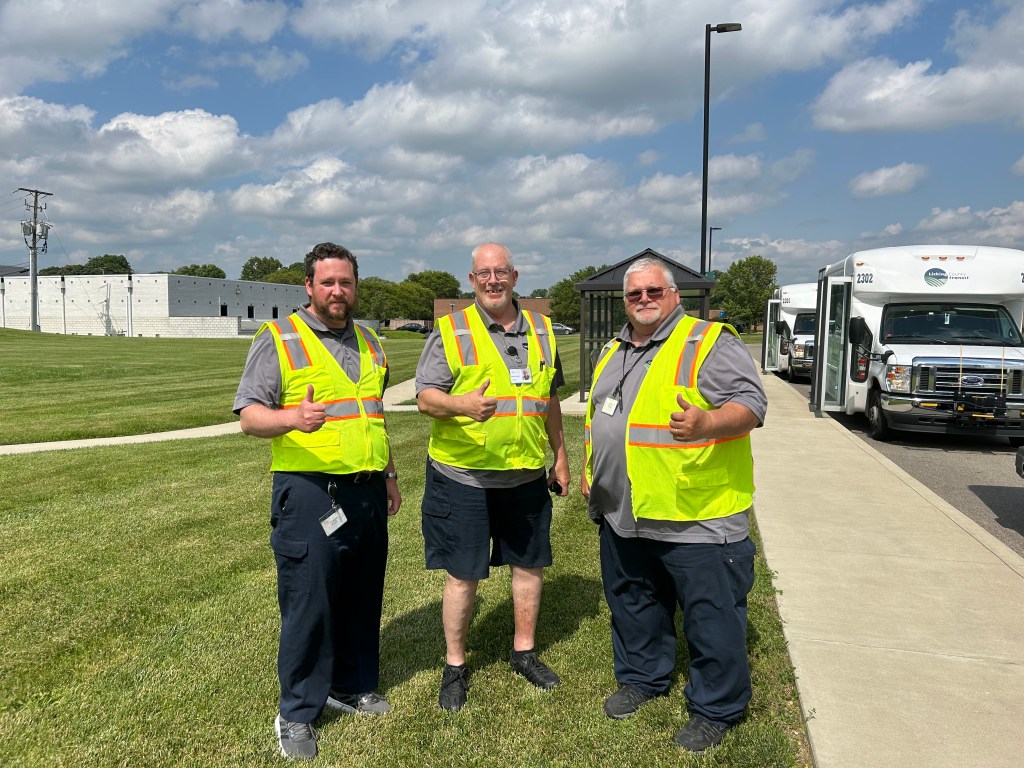
Tyler McCallister, Dennis Combs and Wayne Gore are operators for the Licking County Transit bus routes. Credit: Emma Baum
McCallister has a similar relationship with his passengers. Though his route is still establishing itself after less than three months in action, he’s already a fixture in the lives of those he transports.
“It’s real cool because this is [the bus drivers’] job, but they’re also like doing service work as well,” said a man who got on during the 4 p.m. stop at the transfer shelter. He and four other men take the bus from a sober living house to their recovery program and back every day.
For these men, the convenience of a ride from door to door isn’t the only thing that makes a difference. While there is a $4 charge for the Licking County Transit’s on-demand bus service, the agency has not yet introduced fares for its fixed routes, making the ride free for all passengers.
Minutes later, the men filed off the bus, calling goodbyes to McCallister and taunting each other for taking too long on the stairs. As the doors closed behind them, McCallister noted that the man he’d picked up earlier, with the slow smoking friend and the Monster energy drink, is a resident at this sober living community, too.
Knowing their passengers isn’t in the job description of Licking County Transit drivers like Combs and McCallister. That doesn’t stop them from making everyday connection and community their business.
It’s eight p.m. in a High Street laundromat and the swish of the washing machines and the hum of the driers are barely audible over the dissonant chords of the latest original song from a Columbus-based punk pop band. An old man opens the front door, the squelch of his shoes against the scuffed tiles evidence of the spring downpour that had turned the now-clear sky thick with swollen gray clouds earlier in the evening.
The man crosses the large, open room, dodging strewn instrument cases and the swinging legs of liner-lidded twenty-somethings as he heads for a machine at the back bank of washers. When asked for an interview, he points to a near-invisible stain on the collar of the white button-down shirt he has procured from his drawstring bag and smiles as he shakes his head no. He empties the rest of the bag into the washer, closes the lid, starts the machine, and walks out the front door, still smiling.
After seven p.m. seven days a week, people washing clothes at Dirty Dungarees Laundromat and Bar are far outnumbered by the musicians and fans of the central Ohio DIY music scene. Born from the 1970s punk rock scene, a wall of windows to the right of the front door reveals the draw for DIY culture’s modern followers: at one end of the space sits an old-school bar, complete with a stained glass pendant light dangling above each booth; at the other is a stage, sparse and dark and dictated more by the audience’s collective imagination than by elevation or any clear marcation.
“It literally is like day and night. It’s just normal, average, everyday people doing their laundry in the day,” said Esther Brodess, who has worked at the laundromat and bar for five months. “But then everything flips over at about like six, seven, eight. And it becomes what Dirty Dungarees is known for.”
What Dirty Dungarees is known for – being a hotspot for heavy music in the area and creating a close-knit community between employees, musicians, and fans – is a reputation they’ve earned quickly. While the business has been open and operating as a laundromat and bar since 1978, it wasn’t until the last decade that they traded the pool tables that once lived at the far end of the bar for live music. That doesn’t mean the laundromat doesn’t bring back memories for those who once frequented it, though.
“My parents went to [The Ohio State University] in the 80s,” said a woman at the bar who identified herself as Maggie. “And I told them ‘I was moving around your campus and I watched this show at this place called Dirty Dungarees.’ And she said, ‘That place is still open?’”
In recent years, the financial strain of running a small neighborhood business has been hard on Dirty Dungarees. The laundromat and bar was bought by a new owner in spring of 2023, and in August of that year, new staff members were brought on, including Brodess, who handles music bookings and social media for the business, in addition to bartending on Thursdays.
“I guess that’s why I started working here,” said Brodess, recalling how they went from a Dirty Dungarees customer to an employee. “I was like, ‘Oh man, shit’s about to fall through.’ When I got on here, there were no shows booked for months. And like now, six months later, we’re almost booked up.”
Bands from as far as California, Washington, and even Finland have reached out to book a show at Dirty Dungarees, though the majority of the groups that frequent the venue are local to the central Ohio area. Employees like Brodess, and longtime customers, pride the laundromat and bar on being an authentic and age-accessible option in the region’s DIY music scene.
“It’s a good doorway for people that are starting in the [DIY music] scene,” said a member of the Hilliard-based band Ink. Dirty Dungarees is currently the band’s main venue. “It’s all age entry, you can step out if you want to, you can relax if you need to, and it’s also pretty much free to come here, which is nice.”
While customers are asked to show an ID when purchasing a drink at the bar, there is no age limit or mandatory entrance fee at the door, though a five to ten dollar donation is recommended.
It isn’t just members, new and old, of the music scene that are welcomed into Dirty Dungarees. The laundromat and bar has also partnered with the Columbus-based nonprofit Goldheart Outreach to provide short-term assistance to unhoused individuals in the area.
Where many other businesses turn away unhoused people in search of a place to warm up, use the restroom, and charge their phone, the staff at Dirty Dungarees makes an effort to treat these individuals , many of whom live in camps near the laundromat and bar, as they would any other customer. Heather FitzGerald, the founder of Goldheart Outreach, sometimes drops by the business and leaves quarters with the staff to pay for the laundry fees of any unhoused person who comes in.
In January, after a few particularly cold days of weather, FitzGerald, whose nonprofit is the only organization in the Columbus area that provides transportation to warming centers, found that the centers were at maximum capacity. Along with a small group of volunteers, she arranged for the basement of a local church to be used as a temporary shelter. Faced with housing 100 people a day for seven days, FitzGerald turned to Dirty Dungarees to wash the dozens of blankets that had been donated by members of the community.
With leftover donation money and some help from Dirty Dungarees staff, FitzGerald transformed a usually tedious task into a memorable moment of community. She tasked some of the unhoused individuals sheltering in the church with manning the washers and dryers, and worked with the owner to hand out two drink tickets to each person. A pizza delivery and the use of the bar’s speaker system turned the chore into a full-blown party.
“That’s the biggest thing that [Dirty Dungarees does] besides all the wonderful stuff of just making us feel comfortable,” FitzGerald said of the relationship Goldheart Outreach and the laundromat and bar have created. “It’s the one place we can go and feel welcome and feel like normal people.”
For FitzGerald, helping unhoused people feel like everyone else, even if only for a few hours, is a crucial part of outreach to the community.
“When the light turns green, just give him a little wave as you drive by and make eye contact with him,” FitzGerald said of the most significant thing people can do when interacting with an unhoused individual. “Because that makes you feel like a human being. A lot of people do not know what it feels like when you haven’t been hugged in months. Everywhere you go, you’re not supposed to be. And so if you can just look at them in their eyes, it’s just such a human connection moment.”
The Dirty Dungarees staff doesn’t just look these people in the eyes. They pull out a chair at the table and invite them to stay a while. It’s what they do for everyone who comes through their door.
“[The mission of Dirty Dungarees is] to provide a space that isn’t trying to take advantage of people and to just revel in community and creativity,” said Brodess.
As if to demonstrate their point, a horned woman with blue lipstick appears out of the crowd and leans over the head of the table to chat. She introduces herself as the bassist in Brodess’ band: in addition to being a former customer and a current employee, Brodess can proudly list ‘musician’ on their list of Dirty Dungarees credentials.
Each night’s show typically features a set from three or four bands, and in between performances, audience members often wander into the laundromat room to use the restroom or fill a 50 cent cup from the bar with ice water from a dented yellow Igloo cooler. On his way to the parking lot for a cigarette, one man stops to retrieve his wide-brimmed fedora from where he stashed it in an out of order drier before the previous set. As he exits the propped back door, one hand groping his pockets for an open pack or a lighter, the front door swings open.
The old man is back, drawstring bag in hand. He grins as he asks two black-lace-clad teens to move from where they are perched on top of the machines holding his freshly washed shirts, and they smile back as they comply, hopping off the steel surface only to hoist themselves up again, on two washing machines on the opposite side of the bank.
In the heart of Columbus, in a laundromat that is also a bar and a bar that is also a music venue, community isn’t just being made. It’s happening, and everyone is invited along for the ride.




 Emma Baum