• By Emma Baum | February 28, 2024 | Published in The Denisonian

    For the members of Doghouse, singing six part harmonies in the men’s bathroom of the Bandersnatch is just another Tuesday night. The band has two new songs to prepare for their show on Saturday night and they’re taking advantage of the room’s acoustics to work out the minor details. Armed with a three-piece horn section, a shared Google Doc song catalog, and genuine friendship, the band is ready to make music, despite the late hour. 

    “It’s a good distraction,” said John Brown ‘27, a music performance major from Atlanta, Georgia. He plays guitar and sings vocals for the band. “Literally right now, I’m worried about this essay, but I come in here and I’m not really worried about anything except music and what I’m creating at the time.”

    Brown has been playing guitar for six years and he is one of the only members of Doghouse with previous experience in a band. A crowd favorite among his bandmates, the original song “John’s Reception” which heavily features Brown in a twist on the Paul McCartney and the Wings song “Reception,” is named after him. 

    “We made that song and we were like, damn, we’re cooking with this one,” said Andrew McCutchan ‘26 about the process of writing “John’s Reception.” McCutchan, a computer science major from Granville, Ohio, plays tenor saxophone. “And John in that song is just beautiful. He’s an animal of that guitar.”

    While the members of the band only knew each other in passing, if at all, before last August, they have become close friends. During practices, they are quick to praise each other’s playing or jump in on a riff someone is mindlessly playing. When Doghouse is all together, silence can turn into a fully instrumented song between one second and the next. 

    “It was just me and John and Eli, after rehearsal,” said Erica Elefson ‘26, a pre-med biochemistry major and music performance minor from Kansas City, Missouri who plays drums and sings vocals for the band. “Everyone else has gone to do homework and they’re singing in each other’s faces. And I was just sitting like, I’m so glad I’m doing this. Like, when else am I going to be in a band?”

    Although they’ve been playing for less than a year, since their first show at Chichella in September, Doghouse has managed to set themselves apart from the rest of the bands that call Denison home. The members of Cat Eat Cat, the newest band on campus, describe themselves as big fans of the group, both personally and musically. 

    “All the bands have been very welcoming to us but I think Doghouse especially is really trying to get us into the scene,” said Noah Holland ‘27, a PPA and environmental studies double major, and a guitarist and vocalist in Cat Eat Cat. “In terms of sound, I think Doghouse has some of the greatest vocals on campus. You can tell they’re having fun on stage.”

    The energy the band brings to their music, whether in the Bandersnatch bathroom or at a weekend frat party, might have something to do with how its members spend the rest of their day. The musicians come from a wide variety of majors, hometowns and class years, and for many of them, the band is the only way they are able to fit music into their daily lives. 

    “I took my freshman year without music because I did music for such a long time in school, and then decided it would be fun to get back into it,” said Cole Tatro ‘26, a pre-med biology major and chemistry minor from Coshocton, Ohio. Tatro plays trumpet and keyboard in the band. “I feel like my day is so STEM filled and I’m always like writing a lab report. It’s kind of nice to get the creative side a little bit.” 

    For Will Lang ‘27, an applied mathematics major from Cleveland, Ohio, playing in the band is also an opportunity to try something new. Before joining Doghouse, he had only ever played in concert bands during high school.

    “I think it’s very important to be outside your comfort zone and do something you never really thought about going into college,” said Lang, who plays alto saxophone in the band. “It gets you a little bit of exposure, but it’s really just about making memories and trying to hone a skill.” 

    While Doghouse has developed a substantial repertoire of classics from a variety of genres, they are looking to branch further into original music this semester. The band has nine originals currently, which they hope to record for an album and release on Spotify in the near future. During shows, the band usually sticks to covers of recognizable songs that they know will get the crowd excited, but they have been encouraged to play more originals by the audience response. 

    “What was so powerful about ‘John’s Reception’ was that we realized, okay, we can bring this kind of funky sounding weird thing and people like that a lot, which was just very interesting to understand,” said Eli Lishack ‘26, an anthropology and music performance double major from Freedom, Pennsylvania. 

    In addition to playing bass and singing vocals in the band, Lishack is also the original coordinator of Doghouse. Through a series of conversations in the dining hall, on the Eisner stairs, and after various ensemble rehearsals, he invited fellow musicians to play, and the group quickly grew from the core instrumentation of Brown, Elefson, Lishack and Elliot Atcheson ‘25, who is abroad for the semester, to the full fledged band that it is today.

    While Doghouse has plans to continue playing for the Denison community, they hope to make their off-campus debut in the coming months. For now, though, they’ll be in whatever practice space they can find, whether it’s a band member’s dorm or a too-small Eisner practice room, doing what they love best: making music. They might even make some memories along the way. 

  • By Emma Baum | February 22, 2024

    At first glance, Family Health Services of East Central Ohio in Newark, Ohio looks like just another clinic. The walls are covered in birth control pamphlets, folded and stamped with the clinic’s contact information, by volunteers from the local high school seeking National Honor Society hours. In between the plastic chairs lining the waiting room, shelves teem with baskets of condoms, business cards for substance abuse recovery programs, and potted plants. If you take a closer look, though, you’ll find posters proclaiming that “Contraception knows no gender.” Walk behind the front desk and you’ll be welcomed into a hallway of patient rooms, the wood paneled walls and carpeted floors giving the space a distinct feeling of home. It’s all part of an effort by Ashley Washburn and her team to provide “stigma free health care to all.” It is, after all, the clinic’s motto. 

    “You can walk in our door and you can owe us 50 bucks from the last time you were here,” said Washburn, who has been with the clinic for six years, and served as its executive director for four. “We’re not going to care. We’re still going to see you. We’re going to treat you the best we possibly can. No matter how you identify, no matter what your social economic situation might look like, it doesn’t matter.”

    Almost 40% of the patients Family Health Services of East Central Ohio treated were above the 100% Federal Poverty Level (FPL) threshold in 2022, meaning that the patients could be eligible for state-sponsored healthcare based on low income. 20% of the patients treated in that same year were uninsured, which Washburn attributes to people falling between the cracks when they do not qualify for Medicaid but cannot afford their employer’s insurance. Using a combination of client payments, independently raised money, and funding from Title X, a government program for affordable birth control and reproductive healthcare established in 1970, Washburn ensures that no patient is turned away because of an inability to pay. 

    In recent years though, programs like Title X have caused just as many problems as solutions for clinics like Washburn’s. In 2019, a set of regulation revisions were passed that prohibited clinics that received Title X funding from referring for abortion as a method of family planning. 

    The new regulations also prohibited medical providers other than advanced practice nurses (APRNs) from counseling patients about pregnancy options. Family Health Services of East Central Ohio only employs two APRNs across four clinic locations in Licking County, Perry County, Muskingum County, and Fairfield County. If no APRN was at a clinic location when a patient got a positive pregnancy test result, the patient could not receive counseling until an APRN arrived. 

    Bill Roddick, an abortion provider and the medical director at Your Choice Healthcare, the independent abortion clinic in Columbus, Ohio, has faced similar regulations that have restricted his clinic’s ability to provide patients with easy, efficient abortion access. Over twenty targeted restrictions on abortion providers (often referred to as TRAP laws) in Ohio prevent all medical providers except for physicians from performing abortions, including medical abortions, like what is offered at Roddick’s clinic. 

    For Roddick, the most troublesome TRAP law requires patients to have a minimum of two appointments with a physician, and they must wait 24 hours between appointments, even when there is no medical reason for a delay. This requirement is especially challenging for patients who have traveled to Your Choice Healthcare from out of state. Since a Supreme Court decision in June 2022 ruled that abortion is not conferred in the United States Constitution, the clinic has seen a rise in patients from states such as Kentucky, West Virginia, and Indiana, where abortion is prohibited past six weeks. 

    “For them, it’s expensive. It’s a hotel room, it’s childcare, it’s travel to and from, it’s days off work,” said Roddick. “And there’s just medically no reason for it. It’s just there to kind of create an additional burden or have a reason for why someone can’t come back.”

    The law was particularly devastating for Roddick, the clinic, and its patients in the months after the Supreme Court decision. For 82 days, abortion in Ohio was banned after six weeks. In most pregnancies, it is difficult to receive a positive test, call and make an appointment, and attend two appointments before six weeks. Roddick estimates that during this time, the clinic turned away 85% of its patients because they had exceeded the six week deadline. 

    “It was a really awful summer,” Roddick said. “ Really just the most difficult thing is knowing that you have the tools and the knowledge to help someone. These meds are five feet away from you at any given time. And you have to say no.” 

    For Family Health Services of East Central Ohio, shifts in administration had a greater impact on their operations than the 2022 prohibitions on abortion. Access to medications such as Cytocec, a pill that softens the cervix and allows for a better IUD insertion, became difficult, leaving the clinic struggling with an inconsistent supply. Whenever they could, the clinic would stock up on medications such as Cytocec, in addition to Plan B, which, during the Trump administration, pharmacies limited access to. 

    “CVS, for example, was saying twice a year is the only amount you can get,” Washburn said. “So we stocked up on that and said, you can get as much Plan B as you need to prevent your pregnancy within means. Obviously my APRNs are distributing it properly. But if they need four a year they need four a year. It’s not the end of the world.”

    Washburn has also seen the demand for Long-Acting Reversible Contraception (LARC) rise in recent years, which she accredits to public concerns about the future of abortion and contraception access. 

    For now, the policies and trends in place usually work with Washburn and her team. The Title X Regulation Revisions from 2019 were repealed when President Joe Biden took office in January 2021, which has created an opportunity for open counseling in the clinic. A particular aspect of Title X that Washburn is excited about at the moment is its allowance for minors to be seen and prescribed contraception without a guardian’s permission. 

    “If mom comes in and says, ‘I want her on the pill,’ but she wants to be on the Depo injection, we have to listen to what the minor wants, which I love,” Washburn said. “I think a lot of providers are doing a great job, but they’re kind of letting mom and dad make all the decisions. So here we really let those individuals empower themselves.”

    Washburn has seen concern among her teenage clients that their parents would be mad if they knew they were receiving reproductive healthcare such as contraception. Some patients have mentioned that they worry their parents will track them to the clinic using apps like Life360, which gives live updates about a person’s location. Washburn attributes the potential negative responses of these parents to a general lack of education about and stigma surrounding reproductive healthcare. 

    In November 2023, Ohio voters were presented with a constitutional amendment on the ballot that would enshrine the right to choose one’s own reproductive healthcare. While the amendment, known as Issue 1, passed with 56.6% of Ohioans voting yes, in Licking County, where the central Family Health Services clinic is and where Roddick lives, the issue only passed by a margin of 2%. 

    “I felt that in my whole soul,” said Washburn, reflecting on the election results. “Like I said, we’ve had some great supporters. But there’s a lot that just think we’re unnecessary, unfortunately.”

    For Roddick, the real test was the special election that occurred in August 2023, three months before Issue 1 was presented to voters. The issue on the ballot was an amendment that would have required a 60% majority for amendments to be made to the Ohio constitution, an increase from the standard 50%. 

    “I have thought for a while and obviously continue to think at this point that if you put abortion in front of the voters, they will approve it,” Roddick said. “I was very worried that they would have to approve 60%. And that’s impossible. I had no reason to think that 60% of Ohioans can really agree on anything. I was very worried about the August special election. Once that had passed, I had a huge, huge sense of relief. Because I was confident that if we’re talking about a simple majority, we would get it.”

    Today, Roddick sees patients up to 10 weeks into their pregnancies, which is the threshold for the medical abortions his clinic performs. Patients who exceed the 10 week deadline are sent to Planned Parenthood’s East Columbus Surgical Center, where they can receive a surgical abortion up to 22 weeks. The fight for reproductive justice isn’t over, though. Both Washburn and Roddick are preparing for the worst in the coming election season, anticipating potential administrative changes that could once again entirely change the way they run their clinics. 

    There might be a long way to go still, but advocates like Washburn and Roddick are prepared to keep providing their services for as long as there are people who need them. 

    “There are people in Licking County and people in Columbus who would move mountains to get people care, to offer choices, to be supportive, whatever their decisions are,” said Whitney Crane, Roddick’s partner of over 20 years and a lifelong abortion advocate with a background in public health. 

    Education, Washburn says, is key. So, until reproductive healthcare is easy and accessible to all, she will keep folding pamphlets. Somehow, the shelves always end up empty eventually. 

  • By Emma Baum | February 22, 2025 | Published in The Denisonian

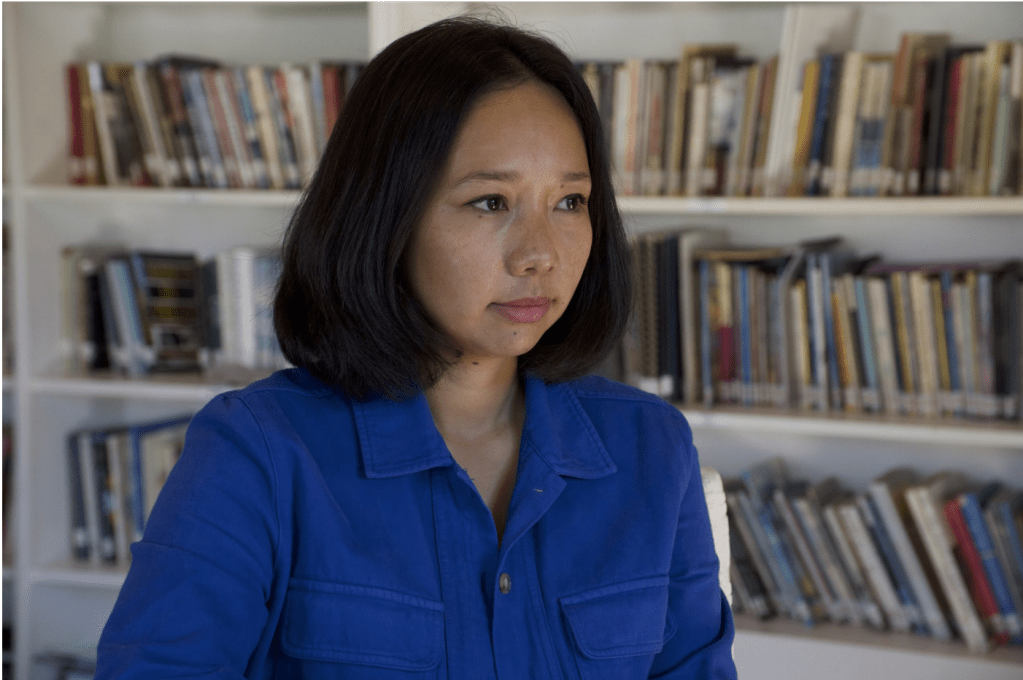
    Seated among the Andean and Amazonian artifacts of the Denison Museum’s current exhibit, over 30 students, faculty members, and local patrons of the arts gathered Wednesday, Feb. 14 to welcome 2023 Great Lakes College Association Prize winners Tsering Yangzom Lama and Lars Horn to campus. Introduced to the audience by Professor Margot Singer of the Department of English, the authors dedicated most of the hour-long event to reading excerpts from their prize-winning books, and answering audience questions about craft, process, and inspiration.

    Before their careers, neither Lama nor Horn set out to be an author. 

    “I was racking up all of the credits to do a philosophy double major with international relations,” Lama said of her time as an undergraduate student at the University of British Columbia. “But then I took a creative writing course, just as an elective, and the professor told me to apply for the major. And I just thought, Okay, fine, I’ll give it a shot. I didn’t think I would get in and I did get in.” 

    Born in Kathmandu, Nepal, and raised in Vancouver, Canada from the age of 12, Lama went on to receive a B.A. in creative writing and international relations, before fully devoting herself to writing during her master’s program at Columbia University. Her debut novel, We Measure the Earth with Our Bodies, was published in May of 2022, and in addition to being awarded the 2023 GLCA New Writers Award for Fiction and the Banff Mountain Award for Fiction & Poetry, has been nominated for eight awards in fiction, provocative writing, and debut novels. 

    The child of two artists, Horn was encouraged as a student at the University of Edinburgh to pursue a degree that would lead to a traditionally stable career. 

    “My parents had struggled with the whole arts and the money and finances, and they said, do a degree where you might get a job,” Horn said. “And so I did French and Russian. So I did like modern foreign languages and it was thought that that could probably get me into translation, or maybe even ambassadorial work that is much more rigid.”

    It ended up being that love of languages and background in the arts that forged Horn’s unique writing style. Their debut book Voice of the Fish, published in June of 2022, is an essay collection that explores themes of identity, legend, and connection through a uniquely braided structure. In addition to the 2023 GLCA New Writers Award for Non-Fiction, the book has also won the 2020 Graywolf Nonfiction Prize and was named an Honor Book for the 2023 Stonewall Israel Fishman Nonfiction Book Award. 

    “I love to collect. I’ll just read a lot and collect anecdotes or strange mentions of something, and I just think ‘that might be useful’,” Horn said, describing the wide variety of facts and anecdotes they combine to create their essays. “I just think of myself as somebody with a lot of museum cases. I just sort of put things there and wonder when they’ll next come to be of use.”

    Lama also relies heavily on research, to create a foundation rooted in historical accuracy that she can build her fictional narratives on. 

    “It took me a long time to put the pieces together and to get enough of the detail where I felt like I could recreate the worlds of these characters,” Lama said. “And also given that Tibetan history is actively being erased or rewritten by our colonizers, I felt it was really important for me to do a good job, in a sense that this book is a form of history itself. Even though it’s fiction, it is a work of history.”

    Telling the stories of Tibetans is a cause close to Lama’s heart. She is Tibetan herself, and the displacement she has experienced as a result of conflict within the country’s borders has influenced her work both as an author and an advocate.  

    “I feel like I’m from nowhere in a sense. But I feel like that’s a very modern condition, a lot of people feel like they’re from nowhere,” said Lama. “ If you’ve known loss, then you understand a lot of other people who have known loss. I was recently in France, for instance, talking at a festival, and I met with some readers who are not Tibetan, and not French, from Sub-Saharan Africa, and who, reading the book, felt like this was their community, and felt like they were Tibetan.”

    Lama is one of the co-founders of LakharDiaries, an online platform where young Tibetans across the world can connect over Tibetan food, clothing, and language among other things, in solidarity with those still in the country fighting cultural oppression. 

    While Lama uses her writing to explore her Tibetan heritage, Horn’s essays often dive into their experiences with their transness– sometimes literally. 

    “I think my love of water really does come from how I try and navigate being in a body from which I feel sort of disjointed to and it intersects with my transness,” Horn said, reflecting on the references to the aquatic that can be found in much of their work. “When you’re swimming, there’s a lot of sensory deprivation. Suddenly, rather than having to navigate that exteriority of the body you get to enjoy selfhood as an interiority that radiates.” 

    In the wake of their successful debuts, both authors have ambitious projects on the horizon. Lama is in her third year of research on a more fantastical novel, taking place in Tibet along the Silk Road over one thousand years ago. Horn is also looking beyond the mundane in their upcoming book that combines writings about NASA’s Voyager probes and space exploration with ancient burial rites. For the time being, though, the pair will be making appearances at a number of other regional universities. As for their visit to Denison, Horn had high praise.

    “There’s something I think that slightly borders on the holy about universities, which sounds maybe a little idealistic, but I really love that there’s a place for curiosity, learning, investigation, and hopefully, at its best community,” Horn said.

  • By Emma Baum | December 1, 2023 | Published in The Denisonian

    Editor’s note: President Adam Weinberg emailed a response to the campus in the form of a Community Update Nov. 13 encouraging students and faculty to root their engagement in the principles of a liberal arts education.

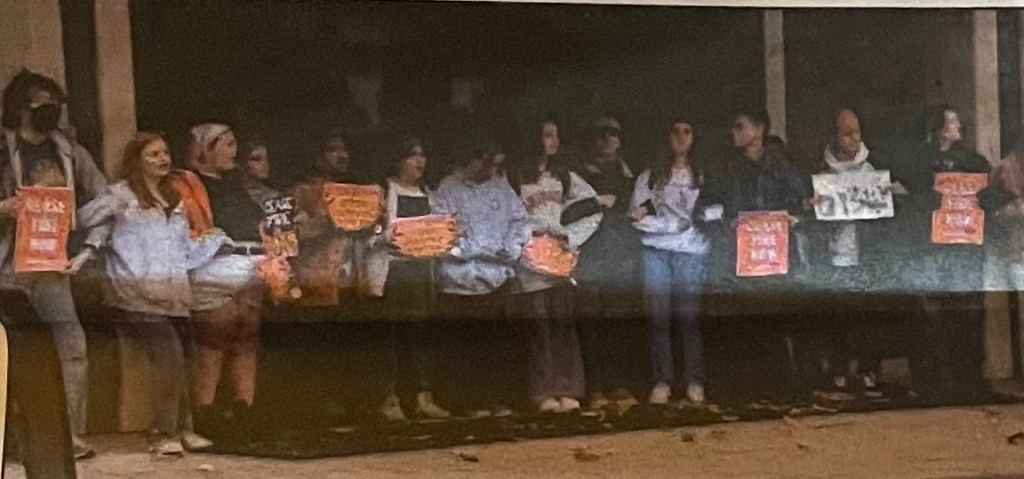
    As the clock struck 11 on the morning of Nov. 9, students across campus walked out of class to congregate in front of the main entrance to Slayter Union. By 11:20 a.m. over 60 students had linked arms in order to block the doors, drowning out the Swasey bells which marked the beginning of common hour with chants of “Not another nickel, not another dime no more money for Israel’s crimes,” and “Free free Palestine.”

    As students and faculty poured out of academic buildings on their way to lunch or work in between classes, many paused to observe the demonstration organized by
    Denison Students for Justice in Palestine, Denison Democratic Socialists of America, and Denison Muslim Student Association to what would be known as the national “Shut It Down” call for Palestinian liberation.

    “In my time here, I just haven’t seen a demonstration like this,” said one senior who stopped to watch. “Whether you take a side or you’re neutral, I think you should at least be observing this.”

    By 11:30 a.m. about 30 students and faculty sat and stood scattered throughout the academic quad, watching the demonstrators. Using the steps leading up to the flagpole as a makeshift dais, several students and faculty spoke to the crowd, urging members of the picket line to stand their ground despite the cold and the risk of penalty from the university and fellow students.

    Campus Safety arrived at just after 11:30, and according to students in the picket line, did nothing when several students came out of Slayter and attempted to physically break the picket line by pushing aside members. Shortly after, Campus Security officers who were standing between the doors of Slayter and the picket line warned that the demonstration warranted disciplinary action and that Granville Police Department could be called in.

    Campus Security was not the only one to express displeasure with the picket line. Individual students engaged in gestures such as flipping off the students demonstrating, giving them thumbs down, and continuously attempting to push through the picket line as they exited Slayter Union.

    Granger Brown ‘25 walked through the bushes behind the picket line rather than turning around and exiting through an alternate door. However, he mentioned how he was not entirely against the demonstration.

    “I don’t feel necessarily attacked by [the demonstration] or anything… like I don’t think it’s directly antisemitic,” Brown said. “I have a lot of empathy for the plight that Palestinians are going through. I also feel a lot of hatred towards Israel for their reaction towards the attack of Hamas.”

    Brown added, “It just feels a little bit alarming as a Jewish student, the amount of unconditional support that Palestine is getting towards Israel, and I feel like also
    Jewish people like underlying that.”

    Monica Bradford ‘24, a member of the picket line, felt differently.

    “I think it’s my duty to speak, my duty to stand with Palestine,” said Bradford. “I am Jewish. I have family in Israel… I think it’s my duty to show that even Jewish people, even people who have Israeli family, can both pray for the safety of Palestinian people and pray for the safety of Israeli people, but not support what the
    Israeli government is doing and actively speak out against it.”

    As the demonstration continued, flyers with the demands of the demonstrators, written as a joint statement with similar groups at Kenyon College, Oberlin College, and the College of Wooster, were handed out to students passing by. The statement included demands for the universities to publicly call for an immediate ceasefire, uphold students’ rights to free speech, and divest from Israeli arms corporations.

    At 11:45 a.m. the names of Palestinians who have died because of the conflict over the last month were read, followed by a moment of silence. The picket line dispersed shortly after as members of the demonstration moved to the fourth floor of Slayter for a town hall on the issue. In the aftermath of the demonstration, there didn’t seem to be a definitive answer as to how Denison would address the conflict.

    Brown encouraged the University to maintain its current public stance of neutrality in the name of freedom of thought, while Bradford expressed hope for a response from the University in spite of her doubt of such a thing happening.

    “I feel like the university should respond. I think that’s a way of being engaged with your student body. Do I think they will? I don’t know,” said the senior observer.